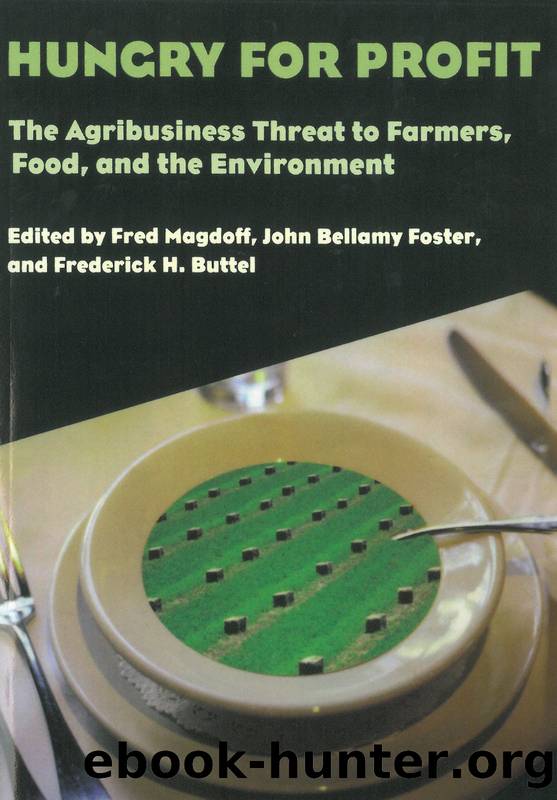
Hungry for profit by Fred Magdoff & John Bellamy Foster & Frederick H. Buttel
Author:Fred Magdoff & John Bellamy Foster & Frederick H. Buttel
Language: eng
Format: epub
Publisher: Monthly Review Press
Published: 2000-11-15T00:00:00+00:00
AGRICULTURE AND CAPITALISM: FROM AGRO-COLONIALISM TO AGRO-INDUSTRIALISM
Much of our political-economic understanding of global power relations is anchored in a binary view of the world expressed in the concept of the âinternational division of labor.â In world capitalist history, the metropolitan, or European, world specialized in industry, while the âperipheral,â or non-European, world specialized in raw material and food production. Development came to be understood as the process of overcoming this division, as Third World states sponsored domestic industrial sectors. In this scenario, agriculture is viewed as a specialization to be transcended.
The concept of the international division of labor reinforced the urban-industrial bias of the development paradigm, with agriculture cast as the residual. Moreover, it has obscured the parallel story of the politics of agribusiness in reshaping global political economy and power relations. One reason for this is that the history of development involves two divergent, and yet connected, historical threads that have been blended together in idealist constructions of âdevelopment.â These two threads are the global movements of British and U.S. hegemony, each of which modeled two distinct forms of development. Let me address each in turn.
The former hegemony involved dividing the world along the classic lines of the international division of labor, expressed in the British slogan of âworkshop of the world.â British specialization depended on access to agricultural exports from tropical colonies and New World temperate regions (including the future American âbreadbasketâ). Indeed world capitalism emerged on the pedestal of colonial agricultures, where large-scale slave plantations prefigured the rise of the factory system. Not only did slavery anticipate proletarianization, but also the colonial system generated much of the early capital nurturing the rise of modern industry. More fundamentally, capitalist forms of production (and consumption) first emerged in agriculture, and the global food trade was, and remains, central to the organization of capitalism on a world scale.
In the nineteenth-century, Britain abandoned its Corn Laws (domestic farm protections) and imported its foodstuffs. The strategy was to fashion a global marketplace based on an international division of labor pivoting on a British âworkshop of the world.â This attempt to subdivide the world into a metropolitan industrial workshop and a peripheral agricultural hinterland was central to the political economy of the colonial system. Under Britainâs âfree tradeâ regime, rival European states and their investors consolidated their control over non-European regions, forcing them to specialize in export agriculture and extractive industry to supply the industrial world with dietary and raw material inputs (from sugar and meat to cotton and rubber).
Over the course of the nineteenth century the composition of agro-exports from the non-European world changed, as industrial commodities displaced luxuries such as silks and spices. The new agro-industrial and other raw material commodities entering world trade were for consumption by Europeâs emerging industrial proletariat (sugar, coffee, tea, cocoa, vegetable oils) and expanding factories (cotton, timber, rubber and jute). As this European/tropical interrelationship deepened, another pattern of trade with the ex-colonial settler states (U.S.A., Australia, New Zealand, Canada) emerged which would transform the shape of world agriculture in the twentieth century.
Download
This site does not store any files on its server. We only index and link to content provided by other sites. Please contact the content providers to delete copyright contents if any and email us, we'll remove relevant links or contents immediately.
Life 3.0: Being Human in the Age of Artificial Intelligence by Tegmark Max(5558)
The Sports Rules Book by Human Kinetics(4388)
The Age of Surveillance Capitalism by Shoshana Zuboff(4293)
ACT Math For Dummies by Zegarelli Mark(4049)
Unlabel: Selling You Without Selling Out by Marc Ecko(3663)
Blood, Sweat, and Pixels by Jason Schreier(3625)
Hidden Persuasion: 33 psychological influence techniques in advertising by Marc Andrews & Matthijs van Leeuwen & Rick van Baaren(3565)
The Pixar Touch by David A. Price(3439)
Bad Pharma by Ben Goldacre(3428)
Urban Outlaw by Magnus Walker(3396)
Project Animal Farm: An Accidental Journey into the Secret World of Farming and the Truth About Our Food by Sonia Faruqi(3221)
Kitchen confidential by Anthony Bourdain(3090)
Brotopia by Emily Chang(3056)
Slugfest by Reed Tucker(3004)
The Content Trap by Bharat Anand(2927)
The Airbnb Story by Leigh Gallagher(2857)
Coffee for One by KJ Fallon(2638)
Smuggler's Cove: Exotic Cocktails, Rum, and the Cult of Tiki by Martin Cate & Rebecca Cate(2541)
Beer is proof God loves us by Charles W. Bamforth(2463)
